
VCT 2027: League Format Replaced by Cups and Open Qualifiers

Table of Contents
For three seasons, VALORANT’s top circuit has run on partnership. A fixed set of orgs per region played out league schedules, and everyone else queued up for a yearlong Ascension grind that paid out exactly one promotion. Riot is throwing that whole structure in the bin. From 2027, there are no leagues, no two-tier divide, and no guaranteed seats, just a stack of tournaments where your last result decides your next one.
The slogan Riot keeps repeating says it all: “Everything is a tournament.”
Reasons Behind the VCT 2027 Changes
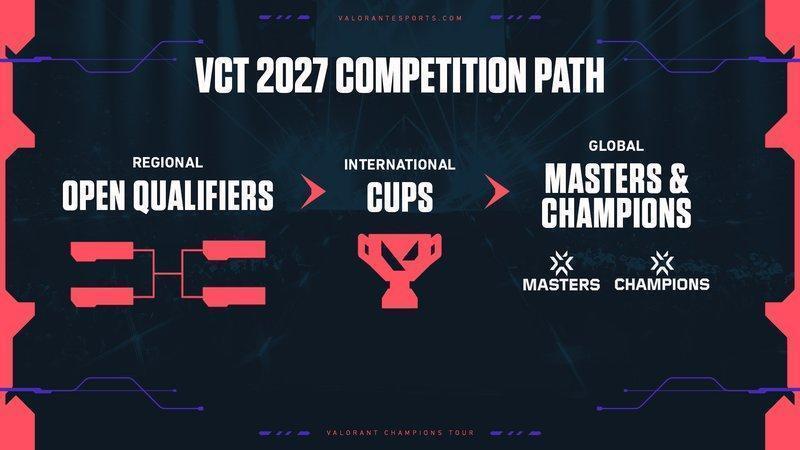
League play had quietly become VALORANT esports’ weak spot. With a closed pool of partnered teams trading weekly matches across two stages, a lot of those games carried little real consequence, and the talent outside that pool had basically one slow, narrow door to walk through. A year of Ascension for a single slot is a brutal trade, and it stopped the scene from refreshing itself.
Tearing out the league tier is the fix. Now, everything routes through elimination brackets, so a win pushes you forward and a loss can send you tumbling back the same week. To pull it off, Riot is running 20-plus tournaments and touring 16-plus cities in a single year.
VCT 2027 Season Structures Three Cycles
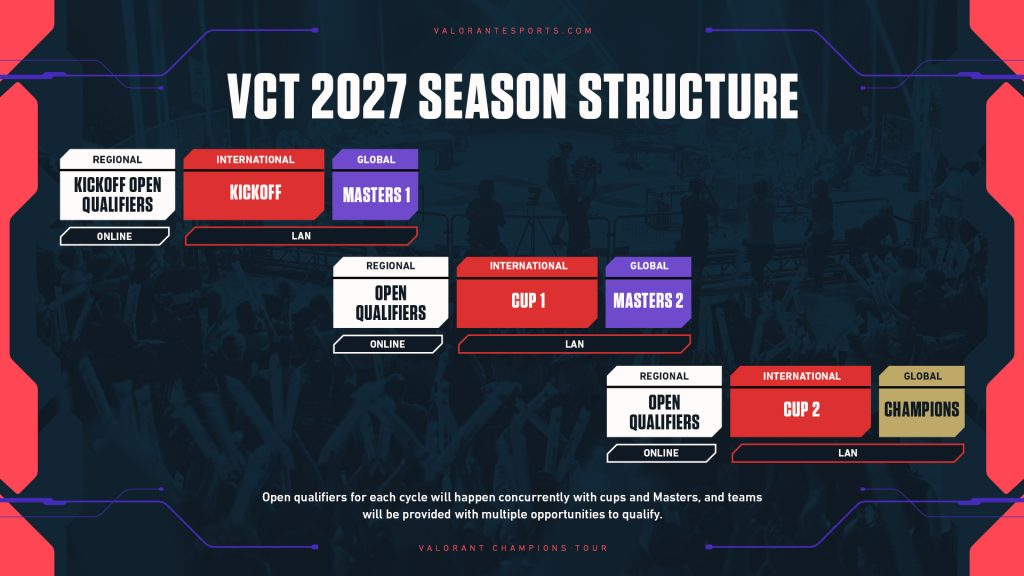
The calendar is three repeating loops. Each opens with online qualifiers and closes at a marquee international event:
- Cycle 1: Open Qualifiers online, then Kickoff on LAN, then Masters 1
- Cycle 2:Open Qualifiers online, then Cup 1 on LAN, then Masters 2
- Cycle 3: Open Qualifiers online, then Cup 2 on LAN, then Champions
Qualifying for the 2027 Kickoff actually kicks off in Q4 2026, the moment VCT 2026 ends. Crucially, each cycle’s qualifiers run in parallel with the Cups and Masters that are happening at the same time, which means one bad bracket doesn’t cost your whole year. There’s always another door.
What Are VCT Cups?
Leagues are replaced by Cups. Picture a LAN bracket run twice a year in each territory. Eight events worldwide span the Americas, EMEA, Pacific, and China, each capped by a live finals weekend and each handing its standout teams tickets to Masters and Champions.
League seasons are slow with little elimination pressure; a Cup compresses that into a short, high-tension run, a series of “punchy,” fast LAN events designed to sort out a region’s best in a hurry.
What Do Partners Keep?
What does a partner slot actually buy? A seat at the season-opening Kickoff, and that’s the extent of it. Each Kickoff is a 12-team triple-elimination bracket (eight partners plus four qualifier teams), and only the top three per territory punch through to Masters. Past that gate, status counts for nothing.
What Do Non-Partner Teams Get?
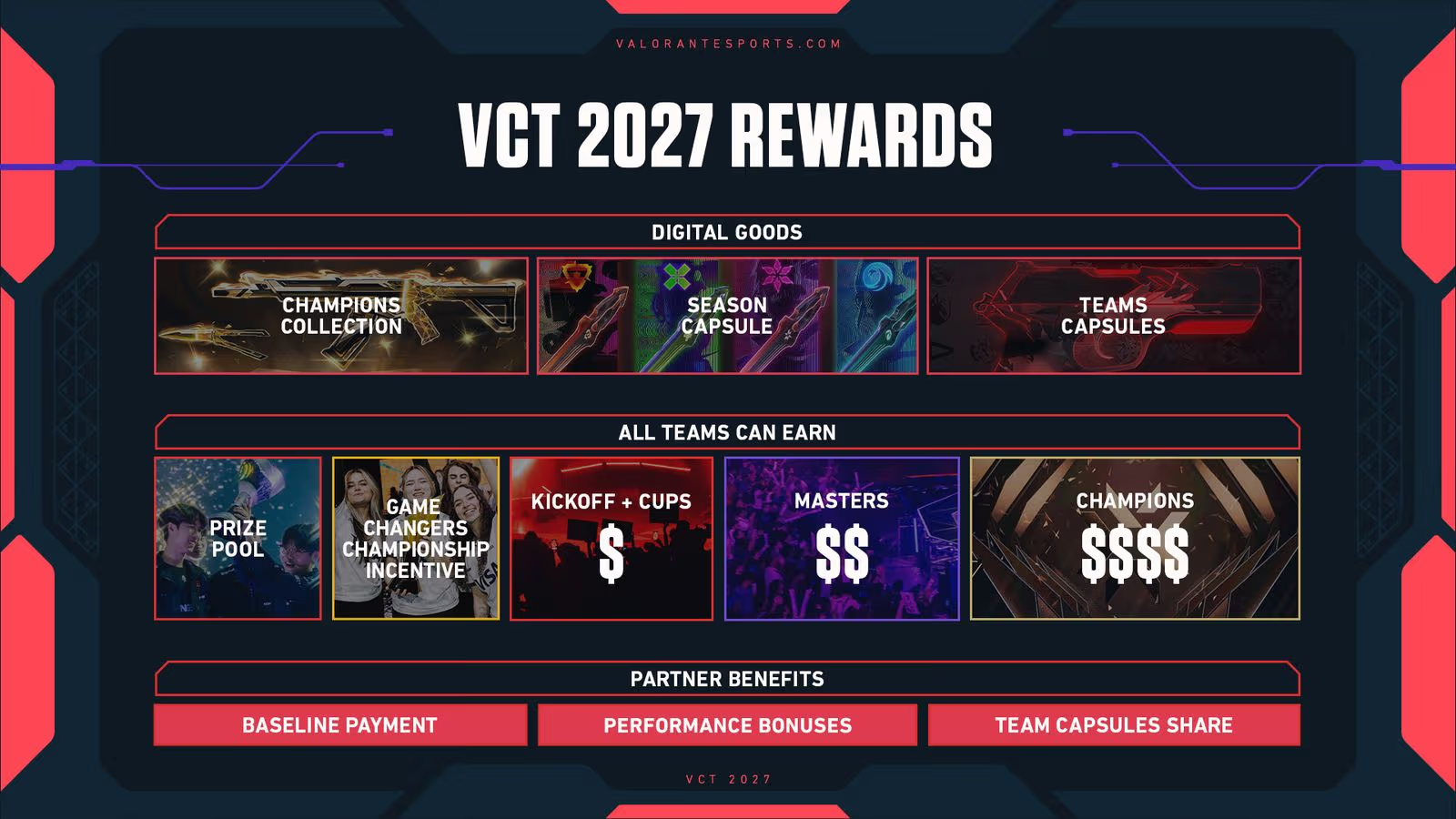
Riot is now writing guaranteed cheques to non-partner teams purely for qualifying, separate from any prize pool:
| Reach this stage | Cash, guaranteed |
|---|---|
| Kickoff or any Cup | $100,000 |
| Masters | $200,000 |
| Champions | $400,000 |
The yearly prize pool exceeds $6 million, and reaching the Game Changers Championship as a non-partner team adds another $100,000. Riot hopes that a deep run can now pay the bills without a franchise contract.
The catch: money and open slots only matter if you can win the bracket. With every result now purely performance-based, raw improvement is the real edge. If you're plotting a 2027 run or just want to climb faster, book a VALORANT coach on WeCoach and turn those open qualifiers into something you actually clear.
14 Sub-Regions Replace the Old 4-Territory Map
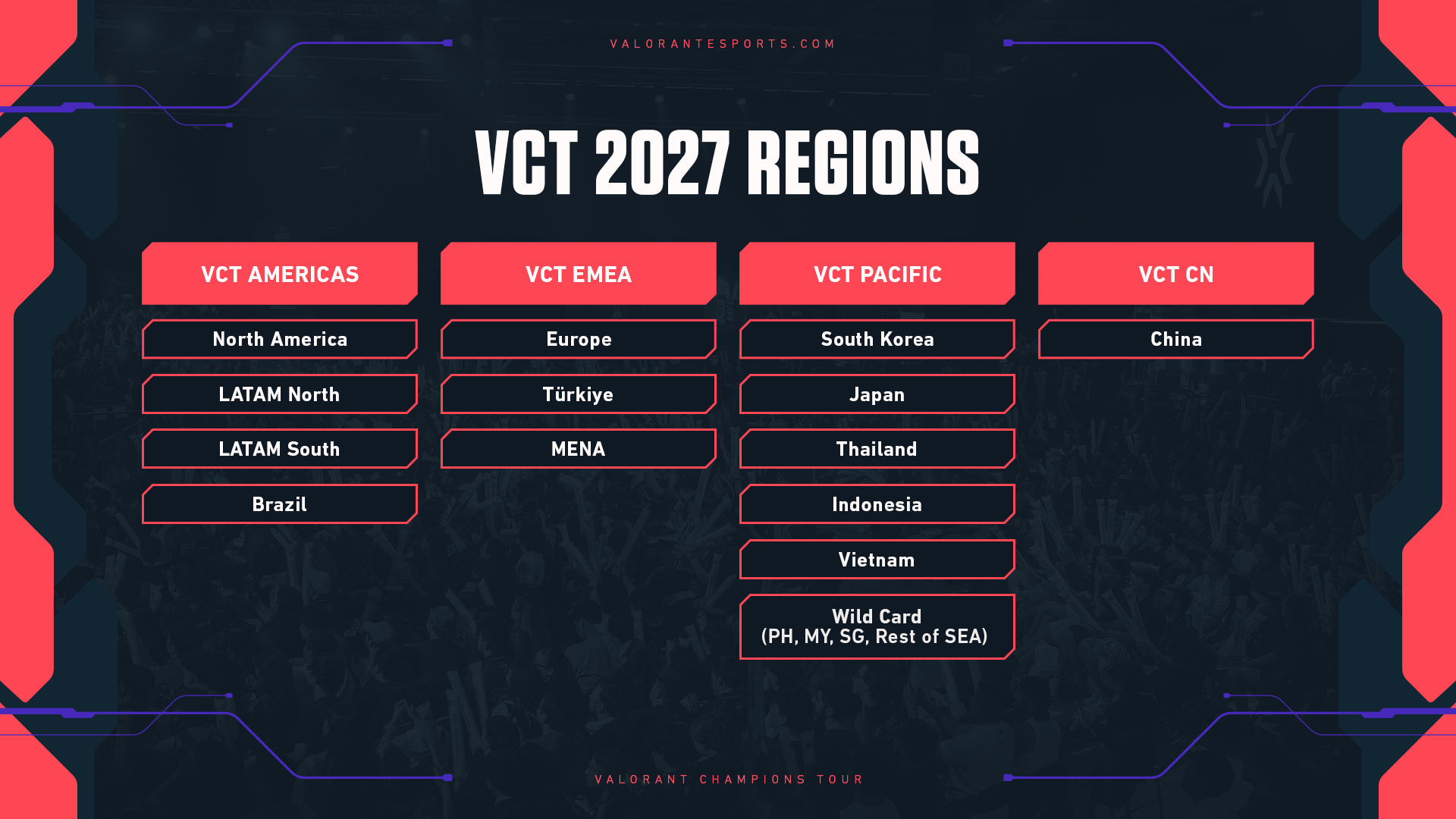
The old four-territory map is being carved into 14 sub-regions, each with a qualifier path of its own:
- Americas: North America, LATAM North, LATAM South, Brazil
- EMEA: Europe, Türkiye, MENA
- Pacific: South Korea, Japan, Thailand, Indonesia, Vietnam, plus a Wild Card bracket (Philippines, Malaysia, Singapore, and the rest of SEA)
- China: running its own structure built around visitor teams
A team qualifies out of its actual home scene rather than drowning in one enormous Americas or EMEA queue.
Why You Can’t Just Swap Your Whole Roster
An open or creator-led team only carries its points and progress forward if it keeps three of its five starters together. Fall under that line and the slate wipes clean.
The three-player rule ensures that teams can’t reshuffle their entire five between events to manufacture a bracket edge, and orgs that actually develop their players get rewarded for sticking with them throughout a season.
VCT China Runs Slightly Differently
VCT China Kickoff seats eight partner teams, two visitor teams, and two open qualifiers, and, unlike elsewhere, both partners and visitors are waved straight into Kickoff and the first two Cups. That visitor-team setup is China-specific and bakes in a promotion-and-relegation route that existed well before this overhaul landed.
Turn knowledge into rank
Get a verified pro to review your gameplay and give you a plan.