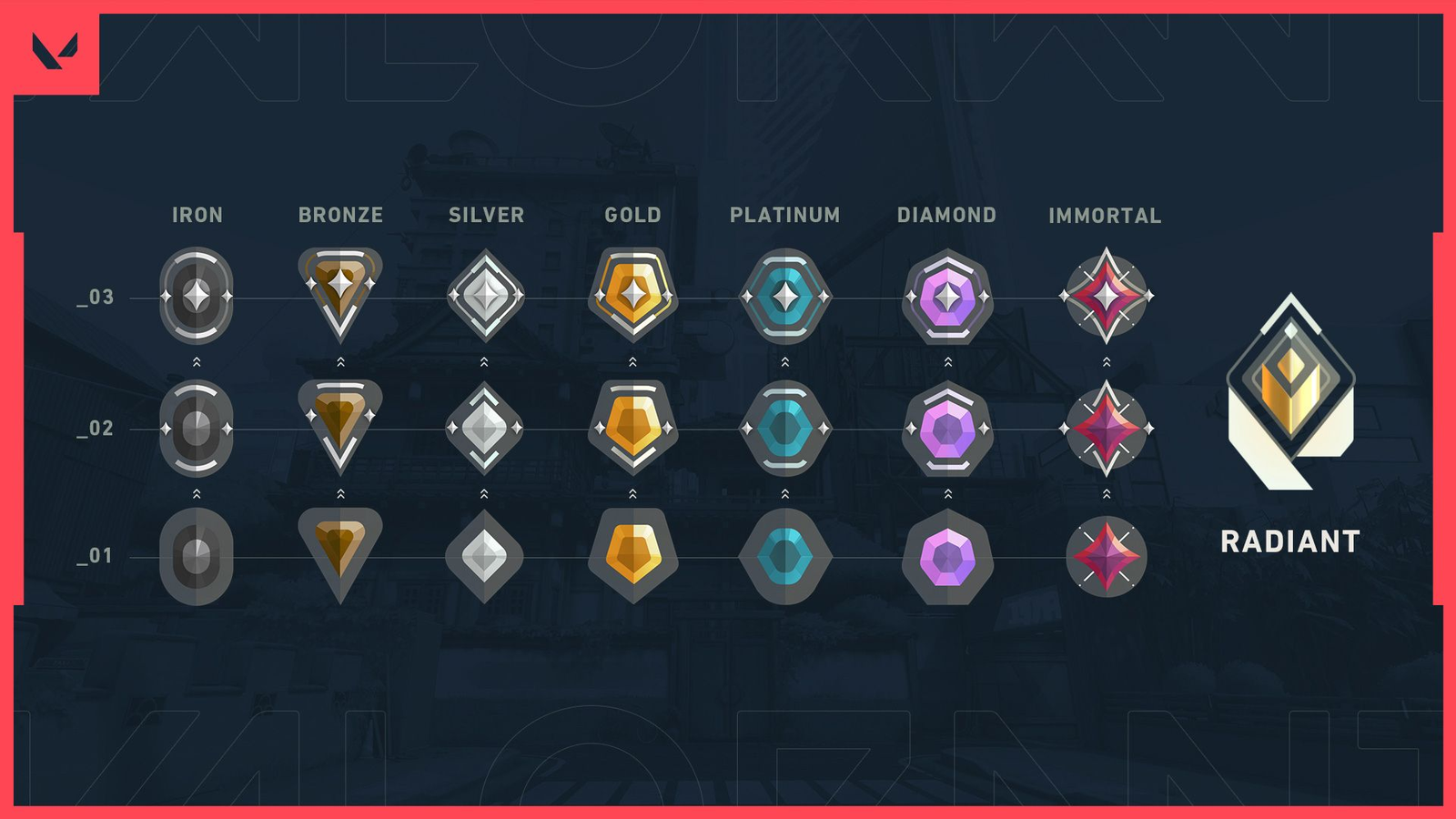
Valorant Ranks in Order: Distribution, RR, and Act Rank Guide

Table of Contents
- Every Valorant Rank in Order, From Iron to Radiant
- How to Play Competitive Mode and Earn a Rank
- Valorant Rank Distribution in V26 Act 2
- How Rank Rating Works at Each Tier
- Act Rank and What the Triangle Really Tells You
- Rank Decay in Valorant
- Premade Size, Rank Disparity, and the 5-Stack Penalty
- The Best Way to Climb Faster
Ask any Valorant player if they deserve a higher rank, and nine out of ten will say yes. The Valorant stats say otherwise. In the V26 Act 2 distribution data, the average ranked player sits somewhere between Silver 3 and Gold 1, which is nowhere near the lobby you picture when your teammate instalocks Reyna and posts a 0-7 scoreline.
If you actually want to climb, you need to know what Valorant's competitive mode is doing under the hood. Not the vibes version. The real one.
Every Valorant Rank in Order, From Iron to Radiant
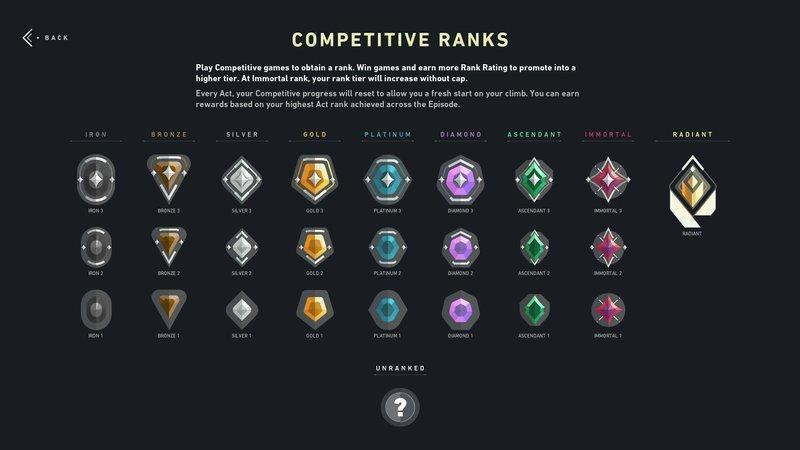
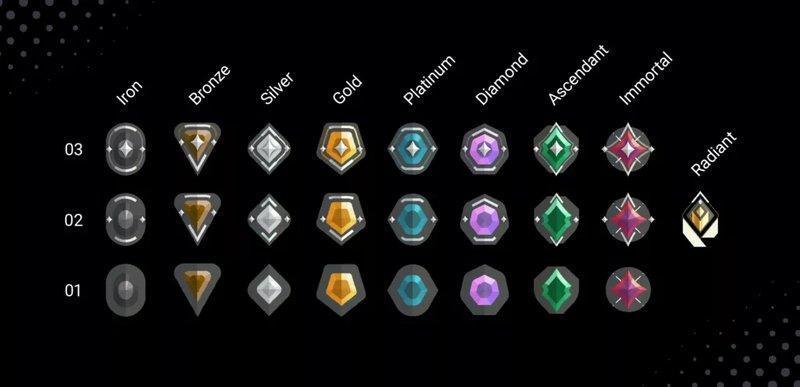
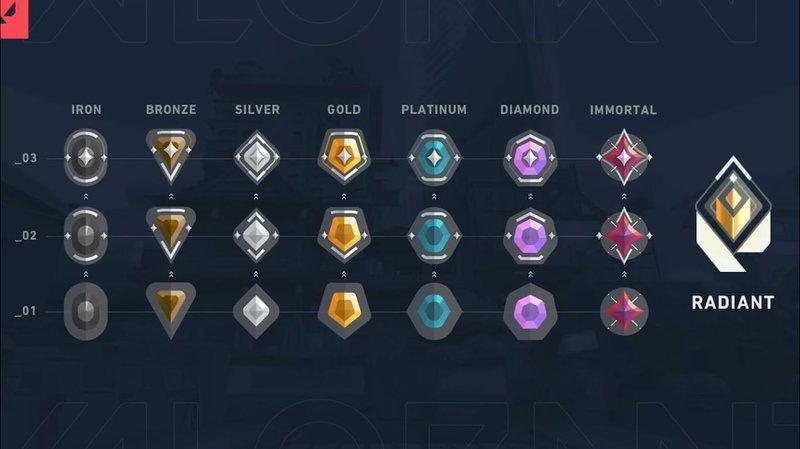
Valorant competitive ranks run nine tiers deep, with three subdivisions inside each tier except the very top. That adds up to 25 total ranks stacked from Iron 1 all the way to the pointy end of the bell curve. Here is the full Valorant ranks order at a glance.
| Tier | Divisions | Role on the Ladder |
|---|---|---|
| Iron | Iron 1, 2, 3 | Learning how to click heads and hold an angle |
| Bronze | Bronze 1, 2, 3 | Building basic aim, crosshair placement, and map sense |
| Silver | Silver 1, 2, 3 | The big congested middle where bad habits live |
| Gold | Gold 1, 2, 3 | The single most populated tier in the whole game |
| Platinum | Platinum 1, 2, 3 | Where utility use and economy actually start mattering |
| Diamond | Diamond 1, 2, 3 | Top 10% of the ladder, the real skill check begins |
| Ascendant | Ascendant 1, 2, 3 | The newer high elo benchmark between Diamond and Immortal |
| Immortal | Immortal 1, 2, 3 | Top 1% territory, regional RR math kicks in here |
| Radiant | One tier, no divisions | Top 500 players per region. That is literally it. |
Radiant is the only rank without subdivisions because it is not really a rank at all. It is a leaderboard spot. If you are not one of the best 500 players in your region, you cannot hold Radiant, no matter how much rank rating you farm. And because the leaderboards shuffle daily, a 501st-place Radiant drops back to Immortal 3 overnight when a better player climbs past them.
How to Play Competitive Mode and Earn a Rank

You cannot queue for Valorant competitive mode the second you download the game, and that is by design. Riot locks competitive matchmaking behind account level 20, which is roughly 20 to 30 hours of unrated, swiftplay, spike rush, or deathmatch time. It is a filter designed to stop brand-new accounts from dragging Iron lobbies into deeper chaos.
Once you hit level 20, you still need to play placement matches before the system assigns you a rank. At the start of a new episode, that means five placement matches. When Act 2 or Act 3 rolls around inside the same episode, you only need one. The highest rank you can earn from scratch during placements is Ascendant 1, which exists to stop smurfs from sniping directly into Immortal lobbies.
To earn the act rank badge and ranked rewards at the end of the act, you need nine competitive wins, not five. Five placement matches get you a current rank. Nine wins earn you bragging rights and the triangle badge everyone shows off on their match history screen.
Valorant Rank Distribution in V26 Act 2
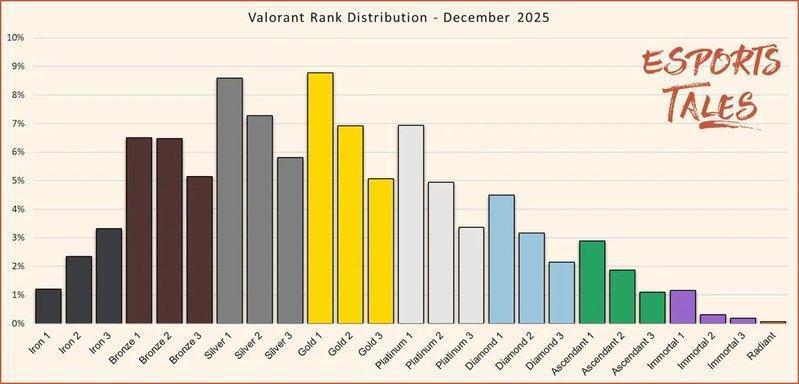
Here is where the wake-up call lives. This is what the competitive game mode population looks like in the current act, based on aggregated V26 Act 2 match data. Every Valorant player should commit these numbers to memory before the next ranked session.
- Iron: 5.91%
- Bronze: 16.76%
- Silver: 22.09%
- Gold: 22.71%
- Platinum: 16.13%
- Diamond: 9.47%
- Ascendant: 5.60%
- Immortal 1: 0.99%
- Immortal 2: 0.20%
- Immortal 3: 0.09%
- Radiant: 0.03%
Read those Valorant stats once, and the rank distribution stops feeling mysterious. Roughly 61% of the player base lives between Silver and Platinum. Gold 1 is the demographic center of the universe. By the time you crack Diamond 2, you are ahead of about 88% of the ladder. Hit Ascendant 3, and you clear 96%.
Immortal and Radiant players barely register statistically. If you ever watch a Radiant stream and think "these lobbies look impossible," it is because you are literally watching the top 0.03% of the competitive game play against each other. The disparity between Ascendant and Immortal is not about aim, by the way. It is about decision-making under pressure.
How Rank Rating Works at Each Tier
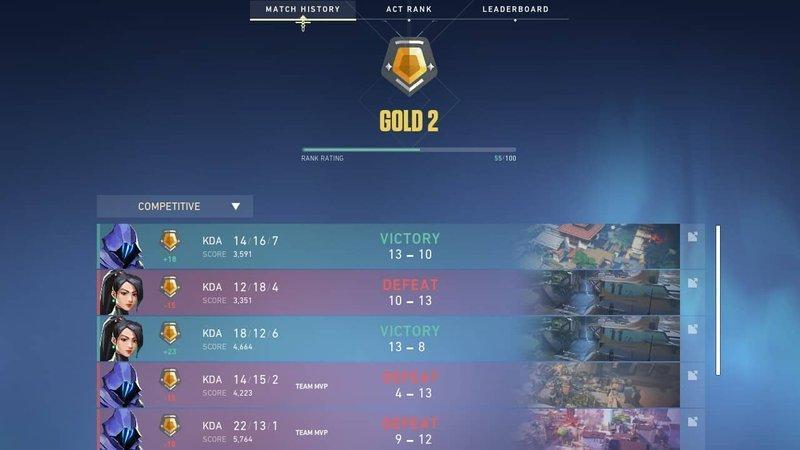
From Iron 1 through Diamond 3, rank rating (RR) is simple enough. You need 100 RR to hit the next division. Wins pay roughly 10 to 25 RR per match, and losses take back a similar chunk. According to Riot's official RR calculation breakdown, the exact numbers bend around three variables.
- Match score. A 13-3 beatdown hands out more RR than a 13-11 scrap, because the system rewards dominance. Stop coasting in overtime when the game is already won.
- Hidden MMR versus visible rank. If the system thinks you are stronger than your current rank, you get fat RR gains on wins and soft losses on defeats. Open your Valorant tracker after ten matches and compare the average win gain to the average loss. If you are gaining 25 and losing 12, your MMR is pulling you up, and you are actively underranked.
- Personal performance. Combat score, kills, assists, first bloods, and multi-frags adjust your RR by roughly plus or minus 5. You cannot gain RR in a loss, but you can definitely protect it with a clutch or two.
Immortal and Radiant play by different rules. At Immortal 1, you start with 10 RR and keep earning indefinitely, and the thresholds change per region. Players in NA, EU, BR, and APAC need 100 RR to reach Immortal 2, 200 RR for Immortal 3, and 300 RR for a shot at Radiant. LATAM and KR cap those thresholds lower, at 90, 150, and 200 RR. Hitting the number is not enough for Radiant either. You also have to be sitting inside the top 500 players in your region at the moment the system checks.
Act Rank and What the Triangle Really Tells You
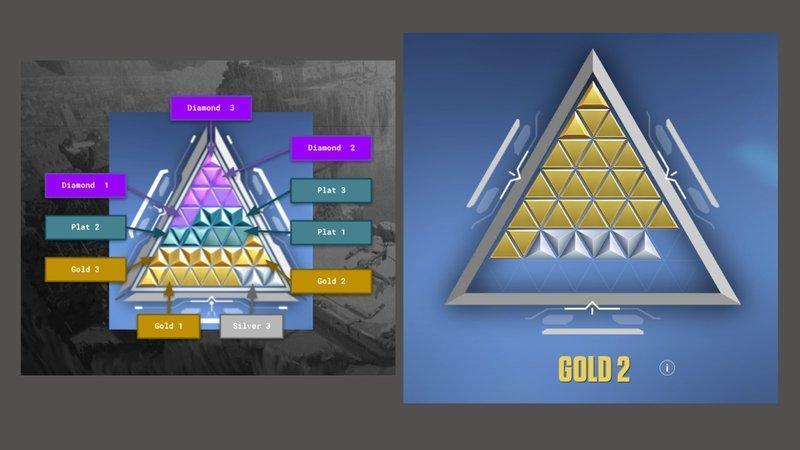
Every act, Valorant builds a second badge next to your current rank called the act rank. It looks like a transparent triangle studded with smaller colored triangles, and it is a surprisingly honest read on how you actually performed.
The act rank triangle fills up with your best nine wins of the act, each mini triangle color-coded to the rank you were sitting at when you won that match. Your highest-ranked win becomes the top triangle, which determines your act rank badge. The border around the triangle upgrades at 9, 25, 50, 75, and 100 wins, so anyone with a gold border put in real competitive play that month.
If you are hunting a specific badge, the rule is simple. You do not need to hold the rank at the end of the act. You just need one solid win at that higher rank, then bank the other eight wins however you can. A lot of Ascendant 3 mains pick up Immortal 1 act badges this way during hot streaks.
Rank Decay in Valorant
Valorant does not have traditional rank decay, despite what your duo partner panicking after a weekend off tells you. You will not lose RR for sitting out. You will not drop tiers for skipping Tuesday's ranked queue.
What happens is that your rank badge is hidden after 14 days without a competitive match. Play one ranked game, and it reappears. The only real reset happens at act boundaries inside an episode. Going from one act to the next, Immortal and Radiant players see their RR reduced by 90%, which is why every leaderboard fixture comes back to Immortal 1 or low Immortal 2 at the start of a new act and has to grind back up through the regional thresholds.
Translation: the system respects your life outside the game. It just does not reward you for being MIA when the next act starts, and the leaderboards shuffle.
Premade Size, Rank Disparity, and the 5-Stack Penalty

Valorant's competitive mode lets you queue solo, duo, trio, or as a full five-stack. Four-player premades are banned outright, mostly because they force the matchmaker to bolt a random fifth wheel onto a coordinated unit, which always ends in Discord screaming.
For parties of two or three, rank disparity is capped so a Silver cannot roll into the queue with a Platinum, and a Diamond cannot queue with an Immortal. The system wants every premade to fit inside roughly the same MMR neighborhood.
Five-stacks are the exception. You can roll a full squad of mixed ranks across the whole ladder, but Riot keeps it honest with an RR reduction. If your 5-stack is Ascendant 3 or below and includes a player outside the standard disparity range, the team takes a 25% RR penalty on wins. If one or more members are Immortal 1 through 3, the team eats the same 25% hit, and if a Radiant player joins your 5-stack, the penalty climbs to 75%. That last number is the reason Radiant mains almost never 5-stack with their Platinum friends. The win is just not worth it.
Queue times scale with premade size, too. Five-stacks only match against other five-stacks, and in most regions, that means longer queue waits at off-peak hours. Solo and duo queues are still the fastest, which is part of why they continue to dominate ranked play across all regions.
The Best Way to Climb Faster
Most players stuck in the Silver-to-Gold sandwich are not losing because their aim is bad. They are losing because they do not know when to take space, how to use utility as information, and which fights to refuse. The Valorant rank distribution shows that those lessons are exactly what separate the 22% Silver slice from the 22% Gold slice just above it and the 16% Platinum layer above that.
If you want the fast lane, working with a Radiant or Immortal coach fixes bad habits faster than 300 solo queue matches. You can book a Valorant coaching session with verified pros on WeCoach and get a VOD review that actually tells you why your post-plant setups keep falling apart at the same execute every time. If your duo partner is the one holding your lobbies together, grabbing them a WeCoach gift card for the next act is the most useful thing you can hand a ranked player on their birthday.
Act rank badges refresh. The decision-making you build while chasing them is what sticks. Learn the maps, respect the utility, trust your MMR, and the next Valorant rank distribution chart will have you in a new slice entirely.
Barry is a gaming writer and former high-elo player covering coaching tips, champion guides, and esports news.
All articles by BarryTurn knowledge into rank
Get a verified pro to review your gameplay and give you a plan.